
Reading Penelope solved a small mystery I ran across in this post from earlier this semester.
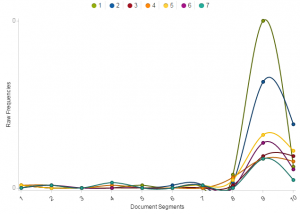
As seen in the above graph, the presence of numerals (that is, “1” as opposed to “one”) increases dramatically toward the end of the book. This is partly due to Ithaca, but it becomes more clear in Penelope, when we note that in Molly’s narration, numbers are expressed solely in numerals. On one level, this is perfectly in keeping with the “shorthand” in which Molly’s thoughts are expressed – there is almost no punctuation (even apostrophes are omitted), “Oh” is rendered as “O,” and similar measures are taken to condense the words she uses into their most compact forms. Thus, it follows that numbers would be written as numerals, using as few characters as possible.
In a way, it runs up against the limits of stream-of-consciousness narration. When one normally thinks of the number twenty-two, one thinks of neither the numeral “22” or the words “twenty-two,” but just twenty-two qua twenty-two. To record this on a page, however, one must make a conscious choice to write either “22” or “twenty-two.” In this way, I think it might be possible contend that rather than the intimate glimpse into Molly’s psyche it is usually described as, Penelope actually highlights the distance between the reader and her thoughts by using writing conventions that emphasize the fact that the words are symbols on a page and unable to convey the immediacy of thought. Perhaps we readers are just as duped as the limitless series of suitors that Bloom contemplates in Ithaca.
Numbers in Ulysses as a whole seem to interpolate three different poles. There are numbers as the language of science (thirtytwo feet per second per second et al.), numbers in a mystical numerological/Pythagorean/religious sense (“darkness shining in brightness which brightness could not comprehend,” the eight beatitudes, the trinity), and then there are the myriad mundane numbers: the prices, debts, and denominations of coins, the odds of the horse-race, the hours of the clock and the many dates recalled, and so on.
Lastly, something I noticed while reading the afterword: As we’ve discussed on several occasions, the number 22 is important in Ulysses in many ways. It’s Stephen’s age, Bloom’s age at marriage, Molly’s age when she first “came properly” (18.1051), twice the age that Rudy would be were he alive, etc. According to Michael Groden’s afterword to Gabler Edition, “the publication date that Joyce wanted” was on February 2nd, 1922, his fortieth birthday, or 2-2-22.
