Author Archives: Thomas Estabrook

First Hyperannotation: Michael Livingston

Livingston, Michael. “”Dividends and Divisors Ever Diminishing”: Joyce’s Use of Mathematics in “Ithaca”” James Joyce Quarterly 41, no. 3 (2004): 441-54.

In this article, Michael Livingston argues that it is a mistake to suppose that Joyce’s use of mathematics in Ithaca was due to Joyce being a skilled (or even competent) student of math. Rather, Joyce was aware of his limitations, and by acknowledging them, readers can gain a deeper understanding of how mathematical error and limits play a role in Ithaca.

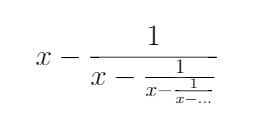
Livingston begins with a very comprehensive survey of mathematical and scientific errors in Ithaca identified by himself and other critics. He then looks to biographical information and Joyce’s notebooks in order to ascertain the extent to which Joyce was fluent in mathematics. He concludes that Joyce was familiar with algebra and Euclidean geometry, but not higher mathematics. (In this he goes against the conclusions of Mines and Dasenbrock, who argue that Joyce had a grasp of some parts of calculus and set theory as well). The one concept from calculus Livingston does identify in Joyce’s notes is the concept of limits that could be approached but never reached, such as:infinite-sumWith Joyce’s lack of mathematical expertise established, Livingston then presents a reading of the math in Ithaca that doesn’t require Joyce to be a mathematical genius. He suggests that Ithaca is an “immense parody of naturalistic and scientific reasoning” (449). The reader of Ithaca, says Livingston, is ultimately distanced from the narrative by the inadequacy of both the catechistic question-answer format (leaving us with only more questions like “Who was M’Intosh?”) and the limitations of scientific concepts at representing reality.
Citations and Related Sources:

McCarthy, Patrick A. “Joyce’s Unreliable Catechist: Mathematics and the Narration of “Ithaca”” ELH 51, no. 3 (1984): 605-18. doi:10.2307/2872940.

Mines, Ray, and Reed Way Dasenbrock. “”Nought Nowhere Was Never Reached”: Mathematics in “Ulysses”” James Joyce Quarterly 35, no. 1 (1997): 25-36. http://www.jstor.org/stable/25473867.

Salvadori, Mario, and Myron Schwartzman. “Musemathematics: The Literary Use of Science and Mathematics in Joyce’s “Ulysses”” James Joyce Quarterly 29, no. 2 (1992): 339-55. http://www.jstor.org/stable/25485263.

Themes: Numbers/Numerology, Science, Biographical Criticism
Final Lexicon Entry: Tooth

Tooth

Forms 

toothless, toothache, toothsome, gaptoothed, toothed, buckteeth

Related Terms

shell, dentist, chew, milk, bite

Explication

Teeth are mentioned many times over the course of Ulysses. Throughout the text, they serve as symbols of power and carnality. In Episode II, Stephen refers to stone lions as “toothless terrors” (U 2.429-30). When Bloom is disgusted by the meat-eating men in Laestrygonians, he observes how one man has “no teeth to chewchewchew it” (8.660). The ever-virile Blazes Boylan keeps a red rose “between his smiling teeth” (U 10.335). In Ulysses Annotated, for the annotation to line 3.495 mentioned above, Don Gifford quotes J.E. Cirlot’s A Dictionary of Symbols, writing that “Teeth are the ‘primogenal weapons of attack’; thus their loss or decay is symbolic of ‘fear of castration or complete failure in life, or inhibition” (Gifford 66).

Teeth are also frequently associated with animals throughout the text. In Episode 5 Bloom encounters a horse’s “gently champing teeth,” (U 5.214) and in Episode 4 he contemplates his cat’s “milkwhite teeth” (U 4.34). The latter example invites connections involving milk, such as the scene with the old milkwoman, or Bloom’s fascination with lactation as described in Penelope.

Finally, teeth also serve as indicators of health and hygiene. In Episode I, Buck Mulligan describes Ireland as a “country full of rotten teeth and rotten guts” (1.412). Most notably, Buck Mulligan frequently refers to Stephen as “toothless Kinch.” Stephen also muses on his poor dental hygiene in Episode III: “My teeth are very bad. Why, I wonder. Feel. That one is going too. Shells. Ought I go to a dentist, I wonder, with that money?” (3.495-6).

Though not encompassing many puns or double-meanings, teeth are connected to many other words and topics in the text. One of these is the word shells, inserted seemingly randomly into Stephen’s interior monologue as he muses about has bad teeth (quoted above). The lexicon offers a variety of meanings for “shells”, including “a symbol for wealth and power,” places of comfort and security, and battlefield explosives. In this particular example, the connection between shells in the sea is interesting, given Stephen’s hydrophobia and fear of drowning.

Teeth are also the bodily organs upon which dentistry is practiced, opening up another realm of connections. In line 1638 of Cyclops, Jack Power asks if Leopold Bloom is a cousin of “Bloom the dentist.” This case of mistaken identity reappears in Circe, when Bloom introduces himself to the Watch as “Dr [sic] Bloom, Leopold, dental surgeon” (15.721). This, then, relates to both Bloom’s interest in science, his tendency toward voyeuristically peering at bodily orifices, and (given the associations between teeth and power, and the fact that dentists heal teeth), perhaps even Bloom’s complicity with Molly’s infidelity.

Definitions and Examples

I. tooth, n (OED 1.a) “In plural, the hard processes within the mouth, attached (usually in sockets) in a row to each jaw in most vertebrates except birds (but also in some extinct birds), having points, edges, or grinding surfaces, and serving primarily for biting, tearing, or trituration of solid food, and secondarily as weapons of attack or defence, and for other purposes; in singular, each of these individually.”

“Blazes Boylan looked in her blouse with more favour, the stalk of the red flower between his smiling teeth.” (U 10.335)

II. (OED 2.b) “Referring to biting or gnawing; hence denoting a hurtful, hostile, destructive, or devouring agency or quality.”

“Every fellow for his own, tooth and nail.” (U 8.701)

III. (OED 3.a) “As an artificial structure, in an implement, machine, etc.; e.g. one of the pointed projections of a comb, saw, file, rake, harrow, fork, etc.; a prong, tine; one of the series of projections on the edge of a wheel, pinion, etc., which engage with corresponding ones on another; a cog.”

“He is prematurely bald from selfabuse, perversely idealistic in consequence, a reformed rake, and has metal teeth.” (U 15.1781-2)

“Eeltraps, lobsterpots, fishingrods, hatchet, steelyard, grindstone, clodcrusher, swatheturner, carriagesack, telescope ladder, 10 tooth rake, washing clogs, haytedder, tumbling rake, billhook, paintpot, brush, hoe and so on.” (U 17.1564)

Related Topics

Bodies
Medicine
Science
Animals
Gender/masculinity

Final Obsession Post: Numbers/Numerology

Last week, not realizing that we had to write an actual summary post for today, I wrote the following:

“Numbers in Ulysses as a whole seem to interpolate three different poles. There are numbers as the language of science (thirtytwo feet per second per second et al.), numbers in a mystical numerological/Pythagorean/religious sense (“darkness shining in brightness which brightness could not comprehend,” the eight beatitudes, the trinity), and then there are the myriad mundane numbers: the prices, debts, and denominations of coins, the odds of the horse-race, the hours of the clock and the many dates recalled, and so on.”

We might say that the first two poles, the mathematical and the mystical, are both attempts to create order from chaos. In the Aristotelian and Platonic worldviews that so preoccupy Stephen, numbers are regarded as unmoving and static, in contrast with the physical world of becoming. For both scientists and numerologists, numbers control our destiny, through laws either physical or divine.

Like almost every other source of stable meaning in Ulysses, numbers in the mystical or scientific sense are drowned out in a deluge of mundane details, puns, and errors. The vast majority of numbers in the text are monetary amounts, grounding number in the very down-to-earth world of commerce and the satisfaction of human desires.

Also interesting is the prevalence of mathematical error. From Stephen’s inattentive view of Sargent’s algebra homework to the many errors and half-truths in Ithaca to Blooms semi-coherent musings about the mathematical basis of music in Sirens.

Ultimately, mathematical meaning clearly breaks down over the course of Ulysses, much like language itself. Beyond that, and a multitude of semi-interesting specific examples of numbers in the text, I don’t have a lot, but I’m hoping to use some of the articles in the Ashplant bibliography to develop and actual argument.


Full Lexicon Entry: Tooth

Tooth

Forms 

toothless, toothache, toothsome, gaptoothed, toothed, buckteeth

Related Terms

shell, dentist, chew, milk

Explication

Teeth are mentioned many times over the course of Ulysses. Most notably, Buck Mulligan frequently refers to Stephen as “toothless Kinch.” Stephen also muses on his poor dental hygiene in Episode III: “My teeth are very bad. Why, I wonder. Feel. That one is going too. Shells. Ought I go to a dentist, I wonder, with that money?” (3.495-6)

Throughout the text, teeth serve as symbols of power and carnality. In Episode II, Stephen refers to stone lions as “toothless terrors” (U 2.429-30) When Bloom is disgusted by the meat-eating men in Laestrygonians, he observes how one man has “no teeth to chewchewchew it” (8.660). The ever-virile Blazes Boylan keeps a red rose “between his smiling teeth” (U 10.335).

Teeth are also frequently associated with animals throughout the text. In Episode 5 Bloom encounters a horse’s “gently champing teeth,” (U 5.214) and in Episode 4 he contemplates his cat’s “milkwhite teeth” (U 4.34).

Teeth also serve as indicators of health and hygiene (In Episode I, Buck Mulligan describes Ireland as a “country full of rotten teeth and rotten guts”).

Definitions and Examples

I. tooth, n (OED 1.a) “In plural, the hard processes within the mouth, attached (usually in sockets) in a row to each jaw in most vertebrates except birds (but also in some extinct birds), having points, edges, or grinding surfaces, and serving primarily for biting, tearing, or trituration of solid food, and secondarily as weapons of attack or defence, and for other purposes; in singular, each of these individually.”

“Blazes Boylan looked in her blouse with more favour, the stalk of the red flower between his smiling teeth.” (U 10.335)

II. (OED 2.b) “Referring to biting or gnawing; hence denoting a hurtful, hostile, destructive, or devouring agency or quality.”

“Every fellow for his own, tooth and nail.” (U 8.701)

III. (OED 3.a) “As an artificial structure, in an implement, machine, etc.; e.g. one of the pointed projections of a comb, saw, file, rake, harrow, fork, etc.; a prong, tine; one of the series of projections on the edge of a wheel, pinion, etc., which engage with corresponding ones on another; a cog.”

“He is prematurely bald from selfabuse, perversely idealistic in consequence, a reformed rake, and has metal teeth.” (U 15.1781-2)

“Eeltraps, lobsterpots, fishingrods, hatchet, steelyard, grindstone, clodcrusher, swatheturner, carriagesack, telescope ladder, 10 tooth rake, washing clogs, haytedder, tumbling rake, billhook, paintpot, brush, hoe and so on.” (U 17.1564)

Related Topics

Bodies
Medicine
Science
Animals
Gender/masculinity

The Unsteady Symbols

Reading Penelope solved a small mystery I ran across in this post from earlier this semester.

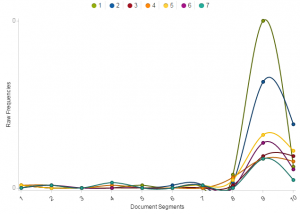
graph2

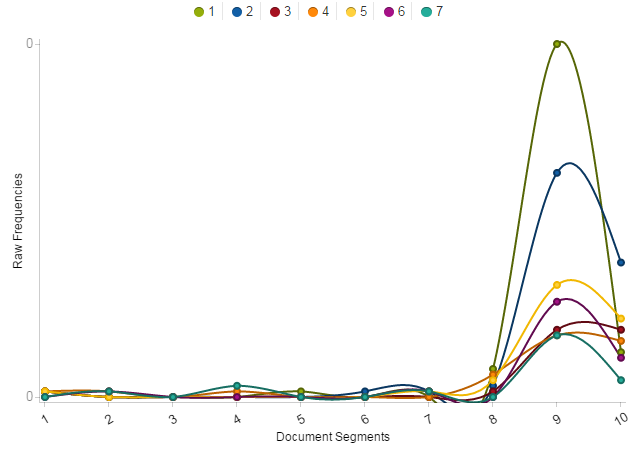
As seen in the above graph, the presence of numerals (that is, “1” as opposed to “one”) increases dramatically toward the end of the book. This is partly due to Ithaca, but it becomes more clear in Penelope, when we note that in Molly’s narration, numbers are expressed solely in numerals. On one level, this is perfectly in keeping with the “shorthand” in which Molly’s thoughts are expressed – there is almost no punctuation (even apostrophes are omitted), “Oh” is rendered as “O,” and similar measures are taken to condense the words she uses into their most compact forms. Thus, it follows that numbers would be written as numerals, using as few characters as possible.

In a way, it runs up against the limits of stream-of-consciousness narration. When one normally thinks of the number twenty-two, one thinks of neither the numeral “22” or the words “twenty-two,” but just twenty-two qua twenty-two. To record this on a page, however, one must make a conscious choice to write either “22” or “twenty-two.” In this way, I think it might be possible contend that rather than the intimate glimpse into Molly’s psyche it is usually described as, Penelope actually highlights the distance between the reader and her thoughts by using writing conventions that emphasize the fact that the words are symbols on a page and unable to convey the immediacy of thought. Perhaps we readers are just as duped as the limitless series of suitors that Bloom contemplates in Ithaca.

Numbers in Ulysses as a whole seem to interpolate three different poles. There are numbers as the language of science (thirtytwo feet per second per second et al.), numbers in a mystical numerological/Pythagorean/religious sense (“darkness shining in brightness which brightness could not comprehend,” the eight beatitudes, the trinity), and then there are the myriad mundane numbers: the prices, debts, and denominations of coins, the odds of the horse-race, the hours of the clock and the many dates recalled, and so on.

Lastly, something I noticed while reading the afterword: As we’ve discussed on several occasions, the number 22 is important in Ulysses in many ways. It’s Stephen’s age, Bloom’s age at marriage, Molly’s age when she first “came properly” (18.1051), twice the age that Rudy would be were he alive, etc. According to Michael Groden’s afterword to Gabler Edition, “the publication date that Joyce wanted” was on February 2nd, 1922, his fortieth birthday, or 2-2-22.

Fallen Bodies, Ten Shillings, and the Year 1888: the Magic Numbers of Circe

While numbers play less of a role in Circe than in some parts of the book, there is nonetheless quite a bit to draw on, especially in the episode’s second half.

Throughout Circe, it is in statements about money that numbers are most frequently used. This is not much different from most of the previous chapters. Where it gets interesting is in the second half of Circe, when Bloom takes over Stephen’s finances. Previously, amounts of money were mostly mentioned in passing, and swept up in the lurid mayhem of Blooms hallucinations: the ten shilling maidenhead, Bloom spending “one and eightpence too much” on the pigs feet, and so on. When he assumes control over Stephen’s wallet, however, there is a definite change. As Bloom slowly rebuilds his senses of identity and masculinity, his ability to manage money allow him to once again assume the roles of Bloom the businessman and Bloom the father. Consider how around line 4290, Bloom confidently dismisses Bella’s claim that Stephen inflicted ten shillings worth of damage.

We also get an indication of both Blooms and Stephen’s ages, on lines 3711 to 3721. Bloom says that 22 years ago, at the age of 16, he fell and cut his hand. Stephen then muses on the fact that 16 years ago, Bloom would have been 22, his own age at present. Apparently, then, Bloom is 38 and Stephen is 22, their births separated by 16 years. I haven’t been able to find much significance to these numbers, but I’m sure they were chosen deliberately. It gets more interesting when one notes that several pages before, Stephen mentions how sixteen years ago (when Bloom was 22), he broke his glasses. Several pages before that, Bloom mentions that he has “sixteen years of black slave labor behind me” (3474-5). (I suspect that Bloom may be referring to his conversion to Catholicism and/or marriage to Molly in 1888, sixteen years ago.) Going back further, on line 3180, Bloom says “ten and six, the act of low scoundrels,” which makes little sense in its immediate context until one begins to see the significance of the number 16.

Finally, “32 feet per second per second” makes two appearances in Circe (That I counted). As the “law of falling bodies,” it takes on extra resonance in this context of lust, guilt, and decay, surrounded by what one might call “fallen bodies.” The number 32 is also, of course, 16 times two.

Numbers in Circe

From what I’ve seen so far, Circe seems to continue roughly the same patterns of number usage as the rest of Ulysses. The overwhelming majority of instances are related to money, which here takes a darker turn due to the fact that in many cases the monetary amounts in question are tied to prostitution.

One of the more interesting things I found is that apparently the line “sixtyseven is a bitch” on line 371 is a reference to Giordano Bruno, a sixteenth-century Italian heretical astronomer/polymath. There’s even a whole academic paper about this one line. In short, Bruno apparently outlined a table of 150 numbered syllables, and number 67 is the sound “ME,” name “Circe,” and has the power “Fascinatrix.”

Lexicon Draft Entry: Tooth

Tooth

Forms 

toothless, toothache, toothsome, gaptoothed, toothed, buckteeth, dental, dentist

Related Terms

shell

Explication

Teeth are mentioned many times over the course of Ulysses. Most notably, Buck Mulligan frequently refers to Stephen as “toothless Kinch.” Stephen also muses on his poor dental hygeine in Episode III: “My teeth are very bad. Why, I wonder. Feel. That one is going too. Shells. Ought I go to a dentist, I wonder, with that money?”

Throughout the text, teeth serve as symbols of power and carnality [cite annotation from Ep. 1]. In Episode II, Stephen refers to stone lions as “toothless terrors.” When Bloom is disgusted by the meat-eating men in Laestrygonians, he observes how one man has “no teeth to chewchewchew it.” Blazes Boylan keeps a red rose “between his smiling teeth” (10.?).

Teeth are also frequently associated with animals throughout the text. In Episode 5 Bloom encounters a horse’s “gently champing teeth,” and in Episode 3 he contemplates his cat’s “milkwhite teeth.”

Teeth also serve as indicators of health and hygiene (In Episode I, Buck Mulligan describes Ireland as a “country full of rotten teeth and rotten guts”).


Definitions and Examples

I. tooth, n (OED 1.a) “In plural, the hard processes within the mouth, attached (usually in sockets) in a row to each jaw in most vertebrates except birds (but also in some extinct birds), having points, edges, or grinding surfaces, and serving primarily for biting, tearing, or trituration of solid food, and secondarily as weapons of attack or defence, and for other purposes; in singular, each of these individually.”

“Blazes Boylan looked in her blouse with more favour, the stalk of the red flower between his smiling teeth.” (10.?)

(OED 2.b) “Referring to biting or gnawing; hence denoting a hurtful, hostile, destructive, or devouring agency or quality.”

“Every fellow for his own, tooth and nail.” (8.?)

(OED 3.a) “As an artificial structure, in an implement, machine, etc.; e.g. one of the pointed projections of a comb, saw, file, rake, harrow, fork, etc.; a prong, tine; one of the series of projections on the edge of a wheel, pinion, etc., which engage with corresponding ones on another; a cog.”

“He is prematurely bald from selfabuse, perversely idealistic in consequence, a reformed rake, and has metal teeth.” (15.?)

“Eeltraps, lobsterpots, fishingrods, hatchet, steelyard, grindstone, clodcrusher, swatheturner, carriagesack, telescope ladder, 10 tooth rake, washing clogs, haytedder, tumbling rake, billhook, paintpot, brush, hoe and so on.” (17.?)

Musemathematics

The passage I’d most like to write about appears in Episode 11, as Bloom muses about the relationship between math and music: “Numbers it is. All music when you come to think” (830). In the subsequent paragraph, he expands on this thought in several ways.

He begins with “Two multiplied by two divided by half is twice one,” or (2*2)/2 = 2(1), which is true, if trivial (830-1). Then, in lines 831-2, we have “One plus two plus six is seven,” an erroneous calculation which presumably is meant to go with Bloom’s next thought: “Do anything you like with figures juggling. Always find out this equal to that. Symmetry under a cemetary wall” (832-3). I think a compelling reading of this is as one of many examples of rational systems of meaning breaking down in the text. Just as language decomposes, so does math, at least as Bloom sees. It also could be seen as a strange dig at Plato – mathematical platonism holds that numbers/mathematical objects exist, and aren’t just mental constructs. Indeed, on lines 834-5 Bloom thinks, “Musemathematics. And you think you’re listening to the etherial.” This could be read as sarcastic or ironic and thus as placing the immediate above the ideal in a manner reminiscent of Stephen’s conversations in the Scylla and Charybidis Episode.

Adding to this is his final cogitation: “But suppose you said it like: Martha, seven times nine minus x is thirtyfive thousand. Fall quite flat. It’s on account of the sounds it is” (835-7). With the final sentence, he seems to conclude that whatever mathematical patterns may underlie music, the appeal lies in “the sounds,” whatever that may mean. It’s interesting that he imagines presenting his mistress wich an algebra problem. I’m not sure what to make of it, though it is another example of ambiguity in that x is either 34,937 or 4,991 depending on the order in which operations are taken. That algebra problems make poor seduction attempts is surely too obvious.

Finally, it’s interesting to note that Ulysses was published nine years before Kurt Gödel proved his incompleteness theorem. Nonetheless, Joyce seems to be anticipating the breakdown in mathematical certainty that it and similar discoveries (or are they inventions?) would precipitate.

Numbers [2]

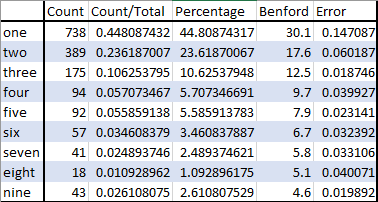
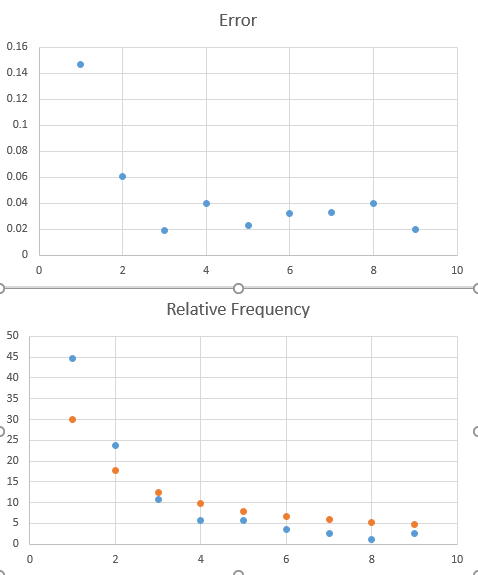
Out of curiosity, I tried using Voyant to roughly test whether Ulysses complies with Benford’s Law. I did searches for “one” through “nine,” and then graphed how often they appear, as well as their deviation from what Benford’s Law would lead one to expect. I was hoping to discover that Joyce had used a particular number unusually often, but sadly no such outliers appeared. Still, it’s interesting to note that this weird statistical law had power even over someone as original as Joyce, especially since deliberately invented numbers often violate Benford’s law (hence its use in fraud detection).

numberlist2

This was my data set, taken from Voyant. The Error column was calculated as |Percentage-Benford|/100

graphs

Here are my graphs. The error is highest for one and two, perhaps in part because “one” has meanings beyond its usage as a number. In the second graph, the blue scatterplot is the frequency of each number out of the total data set, and the orange marks are the expected distribution based on Benford’s law.

One other interesting tidbit I turned up while tinkering with Voyant is that numerals (1 as opposed to “one”) rarely show up except near the very end of the book:

graph2

I’m kind of curious to know why this is.