Monthly Archives: September 2016

Allusions to Homosexuality in “Scylla and Charybdis”

As someone who wrote about the allusions to Oscar Wilde in the Telemachiad for my first blog post, I would like to explore the resurgence of the Wilde references (which were absent in episodes 4-8) in “Scylla and Charybdis,” which also alludes to homosexuality much more directly than previous episodes, particularly as an accusation directed at Bloom. It appears that the pattern of these references is that of a kind of recurrent anxiety, something that intrudes into characters’ thoughts or speech regularly but vanishes just as quickly, nagging and yet marginal.

What is particularly interesting is that while it isn’t particularly unusual to see Oscar Wilde’s work being referenced among a group of Irish artists in this time period (he was hardly an obscure figure!), what is interesting is that a book like Ulysses, so fixated on sexuality and death, would allude to his imprisonment and (in 1900, only 4 years before the novel is set) early death only subtly, even as the same episode probes the life of William Shakespeare for sexual secrets. Mr. Best’s effusive but vague praise of The Portrait of Mr. W.H. – the primary Wilde reference of the chapter – makes no note of Wilde’s biography, but we do see the jarring reference to “love that dare not speak it’s name” from Episode 3 joined by two more repetitions here, at 9.659 and 9.852. Each time, the thought is gone as soon as it arises – in the former instance, the suggestion that Shakespeare “as an Englishman […] loved a lord”(9.660-661) seems to merit no serious consideration, and the latter instance is as but one in a list of aberrations, the “incests and bestialities”(9.851) overshadowing the monstrous nature of paternity. The use of the phrase “love that dare not speak its name” ties these allusions to Wilde – the first repetition in Episode 3 did so directly, as “Wilde’s love that dare not speak its name”, but the way that Ulysses shies away from these connections as soon as it makes them strikes me as peculiar.

I’d also like to bring up another aspect of Stephen’s thoughts that we see in Episode 9 as well as in Episode 3: the regular, brief irruption of memories of his friend Cranly into seemingly otherwise unrelated lines of thought. We have, for example, the “Smile. Smile Cranly’s smile”(9.21) wedged between a tease and a raunchy lyric, and the cryptic memory of “Cranly, I his mute orderly, following battles from afar”(9.136). Although these flashes of memory are not particularly unusual in their content, what is unusual is the refusal of Stephen to pursue them. As much as it may seem a reach, I would like to suggest that this represents anxiety about the friendship’s potentially homoerotic implications, based upon these cryptic lines from Episode 3, which insinuate much and confirm very little: “Staunch friend, a brother soul: Wilde’s love that dare not speak its name. His arm: Cranly’s arm.”(3.450-451).

The only places in this part of Ulysses where the text does not seem to shy away from the concept of homosexuality are the two moments in which Mulligan, glimpsing Bloom, suggests mockingly to Stephen that Bloom is “Greeker than the Greeks”(9.614) and that Stephen ought to watch out. Here, the taunt becomes intermingled not only with antisemitism – Mulligan openly calls Bloom a “sheeny” and asks “What’s his name? Ikey Moses?”(9.607) – but with the theme of Bloom’s sexual incompetence more broadly. The insult against his heterosexuality becomes one of many attacks on Bloom’s masculinity within the novel. I’m curious to look into what other scholars have written on how Joyce deals with (or rather, avoids dealing with) the concept of homosexuality within Ulysses, and how heterosexuality factors in to the novel’s concept of masculinity.
Epithets and Theater in Book 9

The discussion of Shakespeare and theater that dominates Book 9 seemed to set up and lead into a reflective kind of meta-theater enacted by Stephen, Mulligan, Best, and Eglinton. After a couple pages, the narrative starts using epithets, paralleling the Greek prose-poem tradition, for the characters—“beautifulsadness Best,” “ugling Eglinton,” “Monk Mulligan,” “Sonmulligan” (204, 205, 208)—that change according to the role they’re taking on (Buck Mulligan, for example, is at first Monk Mulligan as he intones Latin, but later becomes Sonmulligan when he’s imagining himself to be his own father, clasping his face with “birthaiding hands” (208). As in earlier books, however, the roles assigned and enacted to and by the characters don’t always seem to fit; descriptions in these passages seem discordant and almost nonsensical: Buck Mulligan “gagged sweetly” instead of speaking; all characters “smiled their smiles” (206), a phrase that evokes a kind of strained mechanism.

The role-playing atmosphere also then fits with the play format that’s used for a page: paralleling the discordant role of the descriptions and epithets used earlier, the stage directions seem nonsensical and forced—how does someone speak “A tempo” (209)? I’m not sure at all what that means, but it definitely makes the dialogue seem stiff and unnatural.

Following this passage, I thought the discussion of names was especially meaningful. As Stephen explains it, Shakespeare’s name is “dear to him…dearer than his glory of greatest shakescene in the country” (210). Where Shakespeare’s manipulation of his name is an almost holy revelation, however—“revealed…in the sonnets where this is Will in overplus” (210)—Stephen’s name is a burden, an indication of his spoiled boots and the “holes in his socks” (210). “I am tired of my voice, the voice of Esau,” he reflects (211): like Esau, who disguised his voice to claim his brother’s birthright, Stephen finds himself fraudulent and without poetic integrity. Tellingly, when Eglinton calls Stephen a “delusion” and mockingly asks if he believes his own theory (213), Stephen “promptly” replies “No,” voiding any emotional weight or significance his ideas ostensibly held (213).

Numbers [2]

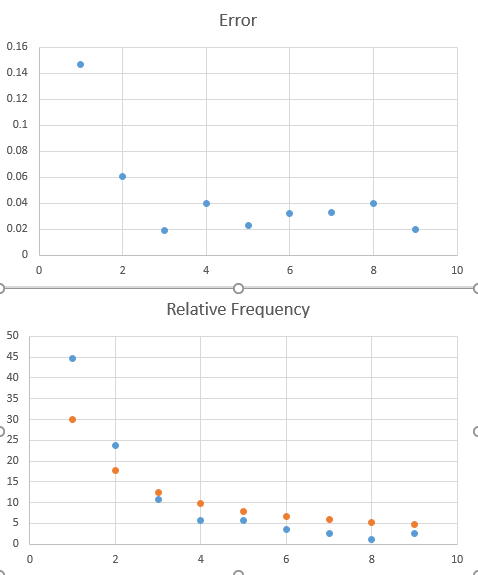
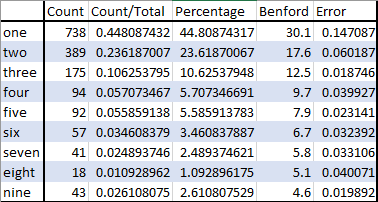
Out of curiosity, I tried using Voyant to roughly test whether Ulysses complies with Benford’s Law. I did searches for “one” through “nine,” and then graphed how often they appear, as well as their deviation from what Benford’s Law would lead one to expect. I was hoping to discover that Joyce had used a particular number unusually often, but sadly no such outliers appeared. Still, it’s interesting to note that this weird statistical law had power even over someone as original as Joyce, especially since deliberately invented numbers often violate Benford’s law (hence its use in fraud detection).

numberlist2

This was my data set, taken from Voyant. The Error column was calculated as |Percentage-Benford|/100

graphs

Here are my graphs. The error is highest for one and two, perhaps in part because “one” has meanings beyond its usage as a number. In the second graph, the blue scatterplot is the frequency of each number out of the total data set, and the orange marks are the expected distribution based on Benford’s law.

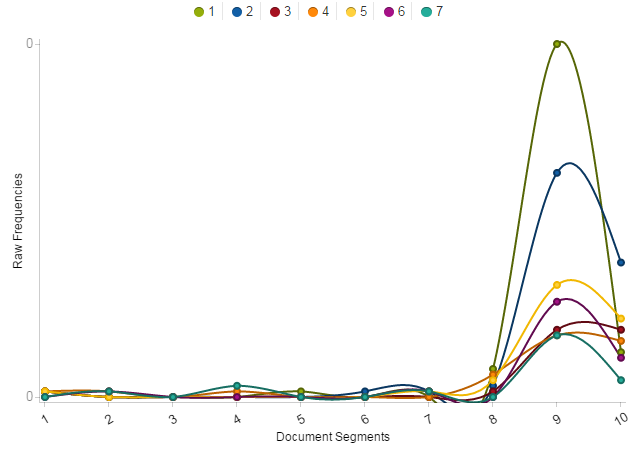
One other interesting tidbit I turned up while tinkering with Voyant is that numerals (1 as opposed to “one”) rarely show up except near the very end of the book:

graph2

I’m kind of curious to know why this is.


Unspoken Literary Allusions in Episode 9

Having the obsession of the “unspoken” gives me slightly more wiggle room in choosing a topic than others, so today I focused on the odd italic lines in Episode 9 that are detached from the text both in physical form and in meaning. I struggled to find a unifying element in all these fragments (I did not find anything on the internet or in Ulysses Annotated), but according to Gifford’s Annotated, many of these fragments are the first line of a poetic stanza. But other than the poetic fragments being from first stanzas, most of the allusions seemed entirely unrelated; many are from unpublished poetic works, others are nursery rhymes or bawdy songs, and the episode closes with an allusion to Shakespeare’s Cymbeline.

Realizing these fragments seem unrelated in content and form, in addition to usually being unrelated to the text of Joyce that they follow, I wondered if they were meant to be completely random elements of literature that surround and fly through this complex, theoretical conversation that Stephen is having in the library. If that is their purpose, then they seem to undermine the conversation that occurs. John Eglinton, A.E., Lyster, and Stephen discuss canonical philosophers, poets, and playwrights in an incredibly complex way, yet that conversation is subverted by fragments of bawdy songs, poems from unpublished and unpopular poets, and common nursery rhymes. From this conclusion, it seems that while Joyce is clearly showing off his own classical knowledge and ability, he seems to be mocking that very decision by destabilizing these canonical authors with low class or literature for the masses.

Below I have included all the examples I looked at and a few short notes on each one.


“First he tickled her Then he patted her Then he passed the female catheter. For he was a medical Jolly old medi …”(9. 22-26)

-Bawdy fragment of unpublished poem

“Orchestral Satan, weeping many a rood Tears such as angels weep. Ed egli avea del cul fatto trombetta” (9. 32-34)

-Lines not from but echoing Paradise Lost: Satan laying on the lake of fire and about to speak angels

“Bound thee forth, my booklet, quick To greet the callous public. Writ, I ween, ‘twas not my wish In lean unlovely English(9. 96-99)

-First stanza of an irish poem meant to be used as guide for ancient poetry but a form lost

“Whelps and dams of murderous foes whom none

But we had spared …” (9. 137-138)

-From a controversial poem by Mr. Swinburne

“Flow over them with your waves and with your waters, Mananaan, Mananaan MacLir …” (9. 190-191)

-From a chant/druid curse that calls down a flood, brings end of days

“In quintessential triviality For years in this fleshcase a shesoul dwelt” (9. 287-288)

-Poem about the death of a child

“How many miles to Dublin? Three score and ten, sir. Will we be there by candlelight?” (9. 415-417)

-Old nursery rhyme

“What of all the will to do? It has vanished long ago …” (9. 798-799)

-Opening lines of first stanza of a poem written in 1926

“Laud we the gods And let our crooked smokes climb to their nostrils From our bless’d altars” (9. 1223-1225)

-End of Shakespeare’s Cymbeline


Lexicon Entry: Mass

There are 4 particular definitions of mass that I believe are especially important to note. (Sorry this is coming in a little later.)

  1. Mass has a primary usage regarding the celebration of the Eucharist during a Roman Catholic service.
    1.  The Eucharist, esp. (in post-Reformation use) as understood and celebrated in the Roman Catholic Church.In the 16th cent. many Protestants objected to the term as unscriptural, and as being associated with the ‘popish’ view of the nature of the sacrament. The German liturgy formulated by Martin Luther in 1526 was, however, called the Deutsche Messe, and Swedish mässa and Danish messe are applied to the Lutheran rite. In the first Book of Common Prayer of Edward VI (1548–9) the heading of the service reads ‘The Holy Communion, commonly called the Masse’, but in the subsequent Prayer Books the word was not used.
  2. Mass also relates to the bodily form or just objects with density in general.
    1. A body of matter, and related senses.
      1. A dense aggregation of objects having the appearance of a single, continuous body.
    2. A coherent body of matter of unspecified or indeterminate shape, and usually of relatively large bulk; a solid and distinct object occupying space.
  3. Mass has also historically been utilized as a verb denoting the actual celebration.
    1. To celebrate mass; to say or sing mass.
      1. To hear or attend mass.
  4. Akin to the object definition, mass can be used as a verb denoting collection.
    1. To form or gather into a mass; to collect, arrange, or bring together in masses; to amass.

      All definitions were gathered from the OED.

Bringing Literature to Life

In “Scylla and Charybdis”, Russell states that “the supreme question about a work of art is out of how deep a life does it spring.” (9, ll.49-50). In other words, he is saying that the most important part of our view of any form of art is how it affects us. According to him, the ideas that come forth are simply just that and they don’t go beyond that. Joyce on the other hand seems to be delving deeper into this statement with the discussion of Hamlet. By arguing that Shakespeare is playing the role of the ghost of Hamlet’s father, or that Ann Hathaway portrayed Queen Gertrude, Joyce opens up the possibility of his own characters representing others. Shakespeare’s son Hamnet, for instance, could be represented by Bloom’s son Rudy, as both boys died young.

We  had discussed in class that Joyce is speaking through some of his characters, like Stephen Dedalus and Leopold Bloom. In this instance, Joyce is zooming out even further, showing that not only to his characters relate to other fictional literary characters, but they can also serve as real people. Questioning the deeper meaning of a work of art, whether it be in written form or painting, allows the audience to make connections to both the real and literary world.

Ulysses as Ascendant Literature

Throughout Ulysses, we are exposed to Joyce’s subtle conceptions and criticisms of religion. Episode 9 features an intriguing conflation of religiosity and Shakespearean discussion. Early in the episode, the writing of Hamlet is considered by the men to be a force that brings their “minds into contact with the eternal wisdom” (52, 152). Immediately, Shakespeare’s literature is depicted as something divine, Shakespeare being an exalted progenitor of sorts.

However, as the episode progresses, the topic of fatherhood is broached and Stephen offers some particularly scathing words, “A father…is a necessary evil” (828, 170). Going further, Stephen makes the claim, “Paternity may be a legal fiction. Who is the father of any son that any son should love him or he any son?” (844-845, 170). Essentially, Stephen argues that fathers and sons don’t have the physical and emotional bonds that a mother and a son would have. They two masculine figures exist to be in tacit conflict with one another, one waning, and one taking the other’s place.

From past class discussions regarding the history of Ulysses publication, we know that Stephen was viewed as a sort of literary alter ego of Joyce. If Stephen is perceived as a written representation of Joyce, and if Shakespeare is described as a father of English writing, do you think Joyce is to some degree challenging the paternalistic legacy of Shakespeare? Do you think Joyce is using Ulysses to make a claim of ascendency, experimental modernist prose finding its place in the wake of the classical verses of Hamlet?

The Boxing Match of Boylan and Bloom

As the day continues for Bloom, his increasing anxiety regarding Blazes Boylan and his likely affair with Molly begins to rule his emotions and his actions. Similar to the previous episodes, Joyce relies on the constant presence of sports and competition to draw additional attention to Bloom’s rising tensions about seeing and interacting with Blazes, as well as his nervousness about going home to Molly. In this episode, Joyce brings in a new sport, boxing, which certainly serves as a good metaphor for this somewhat low-level war between Blazes and Bloom. Blazes continues to appear, with a punch to Bloom’s gut, even if Bloom is merely reminded by him, and more than anything, Leopold is desperate to respond.

In Episode 10, the tenth “section” highlights his obsessiveness towards matching up to Boylan, who Joyce portrays as an ideal man, especially compared to his descriptions of the lowly Bloom, who seems lucky to have landed Molly. Bloom’s efforts to match up are on display as he goes to extreme lengths to find some sexually pleasing literature to bring back to Molly, in an attempt to rival Boylan’s desirability. As Bloom shops, Joyce points out his rather hopeless attempts to measure up in great detail: “Onions of his breath came across the counter out of his ruined mouth. He bent to make a bundle of the other books, hugged them against his unbuttoned waistcoast and bore them off behind the dingy curtain” (596).

In thinking about the extreme lengths Bloom is willing to go to defeat Boylan, is he doing this for the sake of Molly or merely to beat her new lover? Given that Bloom has acknowledged their dysfunctional relationship and sex life, what are his motivations behind engaging this in this uneven boxing match that he seems guaranteed to lose?

Geld

Geld is intriguing in that it has widely varying meaning as a noun and a verb, and also touches on a range of historical contexts. The reference to castration, especially of animals, as well as money, specifically taxes, gives the word almost uncontrollable resonances in the context of Bloom.

From the O.E.D. :

Geld, n.

a. The tax paid to the crown by English landholders before the Conquest, and continued under the Norman kings.

Geld, v.1

a. to deprive (a male) of generative power or virility, to castrate or emasculate. Obsolescent in general literary use; current in technical language with reference to animals.

b. to extirpate the ovaries of (a female), to spay.

a. trans and fig. To deprive of some essential part; to cut down the resources of; to impair the strength or force of, to weaken, enfeeble. Obs.

b. To mutilate (a book, a quotation, etc.) by excising certain portions, esp. objectionable or obscene passage; to expurgate.

Geld, v.2

  1. trans. To charge with ‘geld’.